





Two lives saved – dramatic emergency response just before Christmas
Today, everything seems perfectly natural: Katherina Lazko holds her three-month-old daughter Victoria in her arms. Yet just a few weeks ago, it was by no means certain that both would survive.
On the evening of December 23, 2025, a dramatic emergency unfolded at Magdeburg University Hospital. A patient in the late stages of pregnancy was in acute danger of dying. Several medical disciplines worked in a race against time with the goal of saving two lives.
“The fact that mother and child survived this dramatic situation is the result of close collaboration across all disciplines,” says Prof. Alexander Schmeißer, deputy director of the University Clinic for Cardiology and Angiology in Magdeburg. In addition to medical expertise, a bit of luck also played a role.
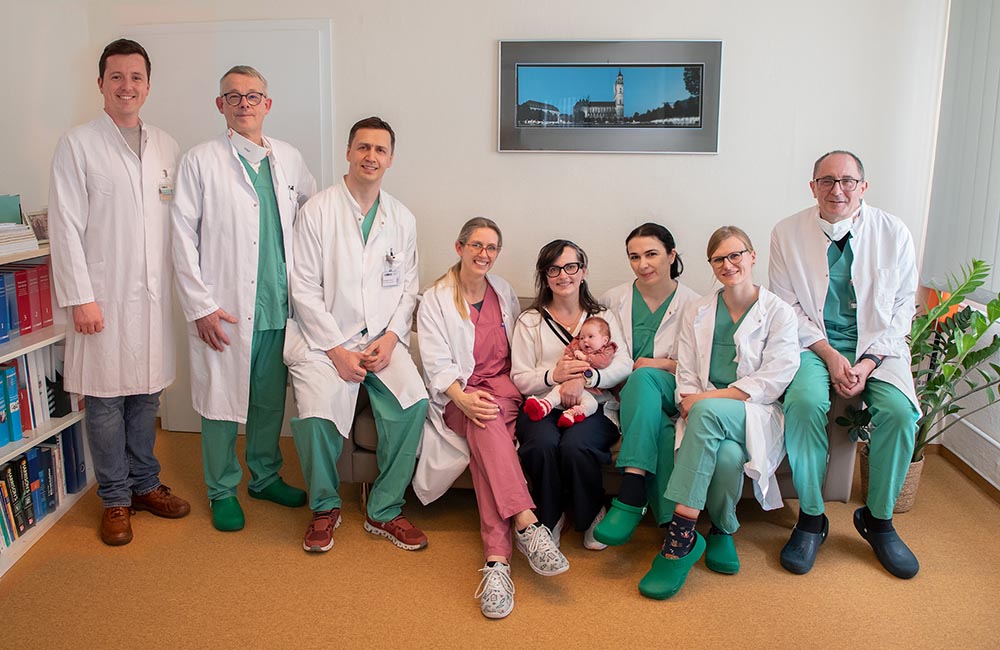
Photo (from left): Dr. József Mészáros, gynecologist and deputy director of the University Women’s Hospital; Prof. Rüdiger C. Braun-Dullaeus, director of the University Clinic for Cardiology and Angiology; Senior Physician Boris Kuzmin, University Clinic for Cardiac and Thoracic Surgery; Dr. Cassandra Kirst, senior physician at the University Children’s Hospital; mother Katherina Lazko with her daughter Victoria; Mariam Janashia and Dr. Marie Tiedge, senior physicians at the University Clinic for Cardiology and Angiology; and Prof. Alexander Schmeißer, deputy director of the University Clinic for Cardiology and Angiology in Magdeburg. Photographer: Melitta Schubert / UMMD
For the physician couple Raman and Katherina Lazko from Salzwedel, this was their third child. The pregnancy initially proceeded without incident. Even at the prenatal appointment on December 18, all tests showed no abnormalities. Four days later, however, severe headaches suddenly set in; painkillers provided little relief. This was followed by restlessness, tremors, severe hypertension, palpitations, as well as nausea and vomiting.
The 35-year-old initially presented herself at the Altmark-Klinikum, where she herself works in internal medicine. At first, there were no clear indications of a serious underlying cause. However, her condition deteriorated dramatically: She began coughing up blood, and the ECG showed life-threatening changes. The patient was transferred to the intensive care unit—shortly thereafter, an emergency call was made to Magdeburg University Hospital.
On December 23 at around 10 p.m., the helicopter landed on the university hospital campus. For such situations, there are clearly defined and well-rehearsed emergency protocols that were immediately put into effect. Dr. József Mészáros, gynecologist and deputy clinical director of the University Women’s Clinic, explains: “The patient was highly unstable. To save her life, we had to deliver her eight-month-old child prematurely—a decision in which we fought for two lives at the same time.”
The central operating room was prepared. “The decisive factor was the immediate, perfectly coordinated collaboration of all involved disciplines,” says the gynecologist. He is referring to the close cooperation between cardiologists, anesthesiologists, obstetricians, pediatricians, and nursing staff.
The patient was suffering from severe acute heart failure. “In situations like this, every minute counts,” emphasizes Prof. Schmeißer. “Only through the well-coordinated teamwork of all involved disciplines and the existing intensive care infrastructure were we able to act so quickly.”
At 12:55 a.m., Victoria was born via C-section. After initial care by the neonatology team led by Senior Physician Dr. Cassandra Kirst, the premature baby was transferred to the neonatal intensive care unit of the Level 1 Perinatal Center at the University Children’s Hospital.
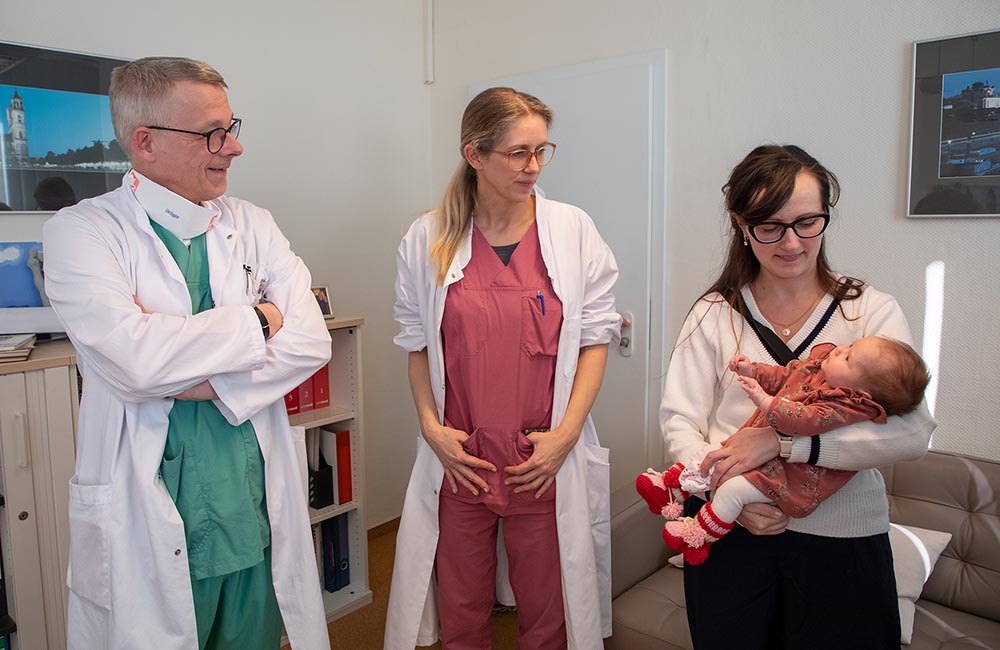
Photo (from left): Prof. Rüdiger C. Braun-Dullaeus, Dr. Cassandra Kirst, mother Katherina Lazko with her daughter Victoria. Photographer: Melitta Schubert / UMMD
“We are trained to regularly care for newborns and premature infants outside our home hospital and are always able to transport very sick children to our perinatal center with our transport incubator team. On this evening, however, care took place outside the usual maternity care facilities, which required a bit more organizational flexibility on our part than usual. Due to the intensive medical treatment of the critically ill mother, it was expected that we would be caring for a child who would initially not be breathing on her own. Thanks to good interdisciplinary collaboration and careful preparation, Victoria was initially ventilated and stabilized. After about ten hours, she began breathing on her own and got off to a good start in life,” said Dr. Kirst.
The mother’s condition remained critical. “Both ventricles were no longer pumping adequately,” explain the cardiologists on duty, Mariam Janashia and Dr. Marie Tiedge. Senior Physician Janashia initially consulted with Prof. Schmeißer by phone. It was decided to connect the patient to an external heart-lung machine (ECMO) that very night to stabilize her circulation. This was done in collaboration with Senior Physician Boris Kuzmin from the University Clinic for Cardiac Surgery. In this way, her circulation was initially stabilized.
However, the disadvantage of this artificial circulatory system was that the heart was subjected to additional strain due to the forced injection of blood. “The heart was increasingly enlarging and threatened to stop pumping entirely, which could have led to circulatory failure,” says Prof. Schmeißer.
To relieve the strain on the heart, the on-call team led by Prof. Schmeißer decided in the morning to additionally insert a small centrifugal pump into the left heart via the femoral artery, which actively draws blood out.
“And it was successful,” says Hospital Director Prof. Rüdiger Christian Braun-Dullaeus. Katherina Lazko has hardly any memories of the first few days after the procedure. She recounts a dream in which she gave birth to a boy. It was only when her husband told her that her child was a girl that she realized she had been in a state of delirium.
For Prof. Braun-Dullaeus, one thing is certain: “Such complex, interdisciplinary emergencies can only be treated around the clock at university hospitals or large specialized centers.” Even for the experienced team, this case was something special: “Even after decades in the profession, a case like this remains extraordinary and deeply moving.”